Services
AI agent development
Custom AI agents that do real work inside your business — reading your data, calling your tools, and checking with a person before anything consequential. Built for production, not for the demo.
An AI agent is a language model that can decide what to do next: look something up, call an API, write to a system, then check its own result. That makes it far more useful than a chatbot — and far easier to get wrong. Most agent projects stall between a convincing prototype and something a business can depend on.
We build the whole thing: the agent, the tools it is allowed to use, the evaluation suite that tells you whether it is getting better or worse, and the product around it. Agentic AI development is engineering, not prompt-writing, and we treat it that way.
What we build
AI agents we build
Customer support and pre-sales agents
Agents that answer from your documentation, catalogue and order data — and cite where each answer came from. When the answer is not there, they say so and hand over to a person.
Operations and back-office agents
Triage tickets, reconcile records, draft replies, update the CRM. Routine work handled end to end, with an approval step on anything that changes money, customers or data.
Research and document agents
Agents that gather context from many sources, extract structured facts from documents and prepare a brief — with a source link on every claim so a person can verify it in seconds.
Workflow automation with LLMs
Classification, extraction and routing across the systems you already run, where a fixed script breaks on real-world input but a model with guardrails does not.
MCP servers and tool integrations
Expose your internal systems to agents such as Claude or ChatGPT through the Model Context Protocol — with typed, permissioned tools rather than open access.
Rescuing a stalled AI feature
Already have an agent or assistant that demos well and fails in production? We audit retrieval, evaluations, cost and failure handling, then fix what is actually broken.
How we build it
What makes an agent production-ready
- An evaluation suite that runs on every change, so quality is measured rather than assumed
- Full tracing — every step, tool call and source is recorded and can be replayed
- Cost and latency budgets per step, visible from the first prototype
- Least-privilege tools and spend limits, so an agent cannot do more than its job
- Human approval on consequential actions, built in rather than bolted on
- Deployed on your cloud, inside your data and compliance boundary
How it runs
01
Intent
classify and route the request
02
Plan
decompose into tool calls
03
Act
typed, permissioned tools
04
Verify
check output against source
05
Deliver
answer, action, audit entry
Related work
Shipped, live, in use.
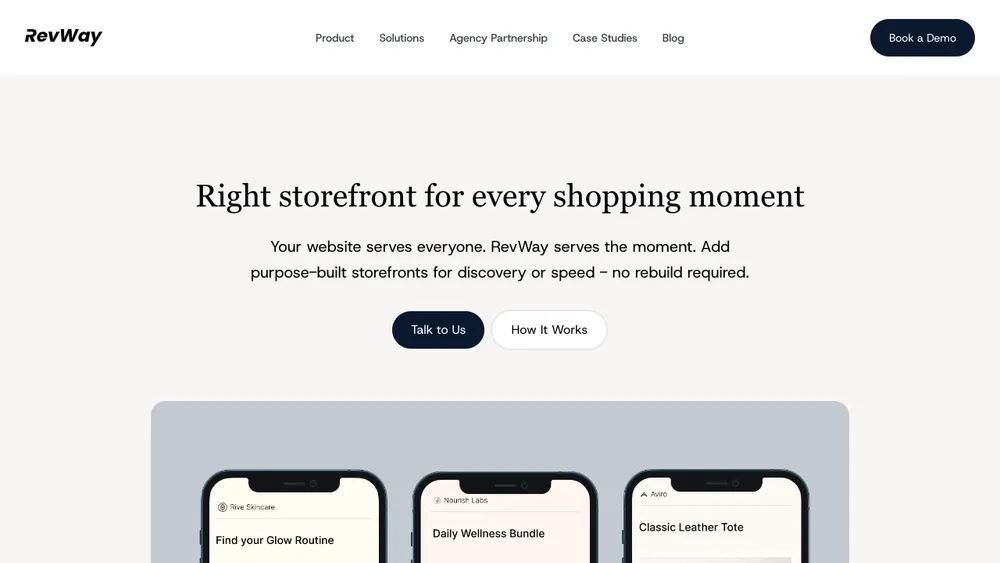
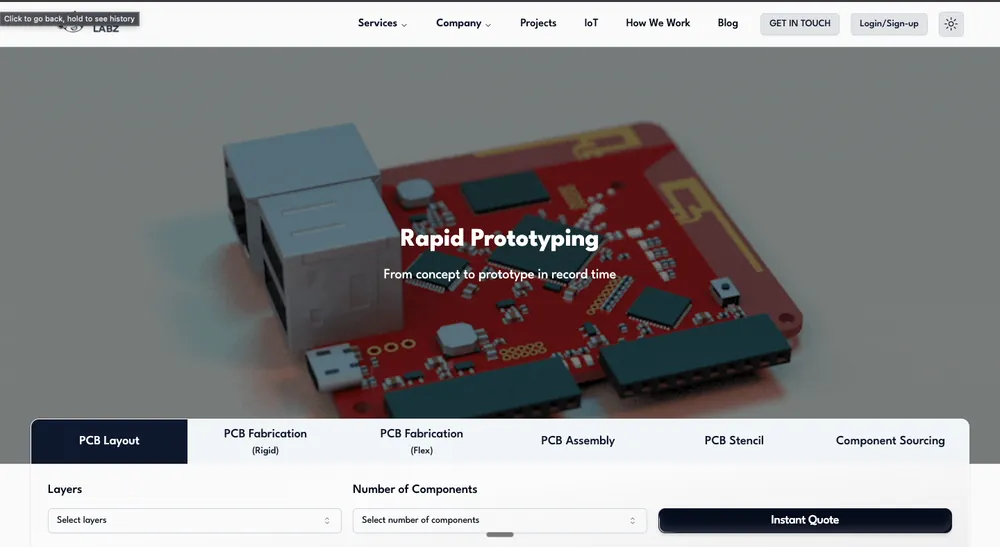
Grounded AI running in production: catalogue enrichment and review Q&A for RevWay, and an in-context product assistant for Strom Labz.
Questions
Frequently asked
What is an AI agent, and do I actually need one?
An AI agent is a model that plans and takes multi-step actions using tools — searching, calling APIs, writing to systems — rather than answering a single prompt. Plenty of problems do not need one: a simpler workflow or a single model call is cheaper and more predictable. We will tell you which one your problem needs before anything is built.
How long does it take to build an AI agent?
A focused first version — one workflow, a handful of tools, running on your real data — typically takes three to four weeks. Taking it to production with evaluations, monitoring and full integrations usually takes eight to twelve weeks, depending mostly on how many systems it needs to touch.
How much does AI agent development cost?
The main drivers are the number of systems the agent integrates with and how much evaluation the use case demands. We give you a written scope and estimate after a first call. Running costs for the model itself are usually small, and we measure cost per request from the first prototype so there are no surprises later.
Which AI models do you use?
Whichever fits the task. We work with Claude, OpenAI models and open-weight models, and choose per step on quality, latency and cost — often a small fast model for routing and a stronger one for reasoning. Nothing in the design locks you into a single provider.
Is our data safe with an AI agent?
Agents are deployed in your own cloud account where possible, with tools that can only reach what they need. Every action is logged. Your data is not used to train models unless you explicitly ask for fine-tuning.
Can you improve an AI agent or chatbot we have already built?
Yes — it is often the best place to start. Most stalled agents fail for a few fixable reasons: weak retrieval, no evaluations, no guardrails, or unchecked cost. We audit what exists and fix what matters rather than rebuilding for the sake of it.
Start here
Tell us what you are trying to build.
One call, no deck. We will tell you what we would build, what it would cost, and which parts you should not build at all.